
How an Agency Ambassador Leads With Empathy, From the Statehouse to a Little Free Pantry
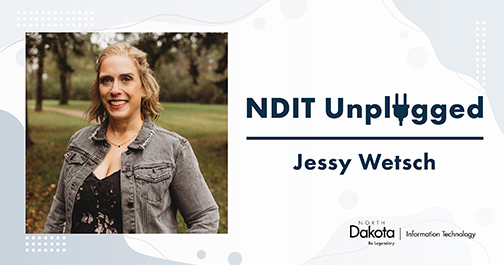
The trunk popped open, and out came a cardboard box packed with canned soup, granola bars, toothpaste samples from a recent dental visit, and a few travel-size shampoo bottles no one quite remembered collecting. Jessy Wetsch handed her daughter a stack of canned goods and her son a sleeve of crackers, and the three of them crossed a parking lot toward a small wooden pantry box on a post—its little door hanging open, mostly empty.
This isn’t a special occasion. It’s wonderfully routine. When the box at home fills up, or when someone spots a grocery sale, the family loads up and restocks Little Free Pantries all around Bismarck. Sometimes one stop, sometimes several, skipping over boxes already full to find those running low.
Over time, it’s become second nature. The kids don’t think twice anymore. Their mom has taught them something simple without it ever being said outright: when you see a need, you do something about it.
That same instinct carries into Wetsch’s work. As a Technology Business Partner (TBP) at NDIT, she spends her days doing a version of the same thing—showing up, listening, and figuring out what’s missing so agencies can move their missions forward. (But more on that in a moment.)
From Chamber to Charity
Wetsch will tell you the pantries weren’t originally her idea. The seed was planted through Leadership Bismarck-Mandan, a Chamber program that addresses real community challenges like housing, education, and food insecurity.
“It just exposes you to so many topics,” she says. “You start seeing where the gaps are, and you want to help fill them.”
Food insecurity stood out. Her project team turned that awareness into action, designing the original pantry concept and even drafting box specifications using AutoCAD, the same software used by Rough Rider Industries to design custom furniture through the North Dakota Department of Corrections and Rehabilitation (DOCR), one of the main agencies Wetsch serves.
What started as a few pantries quickly grew. Community sponsors stepped in, more boxes were installed, and a small project became a citywide network.
Before launching, Wetsch’s team coordinated with Great Plains Food Bank and local shelters to ensure the effort complemented existing services rather than duplicated them. The result filled a very specific gap: people who didn’t qualify for formal assistance—or who simply wanted to access food quietly and with dignity.
Just how urgent the need was became clear during a simple test. Wetsch’s team once timed how long it took a freshly stocked pantry to empty. The average: 16 minutes.
“We just stood there watching,” she said. “It was gone almost immediately.”
The most needed items are the simplest: ready-to-eat canned goods, not ingredients that require other supplies. Many pantries sit near schools, meaning some children quietly rely on them for meals.
Today, the network has blown up communitywide. Wetsch humbly downplays her role, but it’s clear the project wouldn’t have happened without her.

Wetsch walks the walk when it comes to teaching her kids what it means to give back and make a difference in their community.
An Intermediary Agencies Count On
If the pantry work reflects Wetsch’s empathy in its most personal form, her TBP role applies it at the scale of state government.
TBPs sit in a uniquely difficult space: translating between agencies that know what they need and IT teams that know what can actually be built, funded, and supported. It requires fluency in two languages—mission-driven urgency on one side, technical and fiscal reality on the other.
Wetsch currently supports roughly 13 agencies, from small boards to large departments like Commerce, Game and Fish, and Public Instruction. One of her deepest partnerships is with DOCR, where modernization needs are significant and long-standing.
So embedded is she in that work that she often works on-site rather than from NDIT’s main office, and that proximity matters. DOCR has spent years underinvested in technology, and modernization needs often arrive faster than infrastructure can absorb them. Wetsch’s job is to deliver clarity without discouragement—to explain when something isn’t yet possible while keeping momentum intact.
“I love it. Let’s do it,” she’ll often say. “But here’s what needs to happen before we get there.”
It’s not always easy. Agencies have often turned to short-term fixes that created longer-term problems. Wetsch lovingly and genuinely steers conversations toward sustainable solutions, even when they take longer.
That discipline has paid off. Over the past two legislative sessions, DOCR has secured its largest technology funding increases in history. Much of that success came from Wetsch and NDIT translating complex operational needs into clear, fundable priorities for lawmakers.
Now she’s preparing for the next cycle, sorting requests into what’s essential, what’s new, and what’s necessary to maintain basic operations, while also pursuing the ultimate goal—improving outcomes and reducing recidivism.
The work requires trust on all sides. One DOCR colleague even jokes before difficult meetings: “I hate that I have to play the bad cop today. Please don’t take it personally!” Wetsch understands. It’s part of aligning priorities toward the same goal.
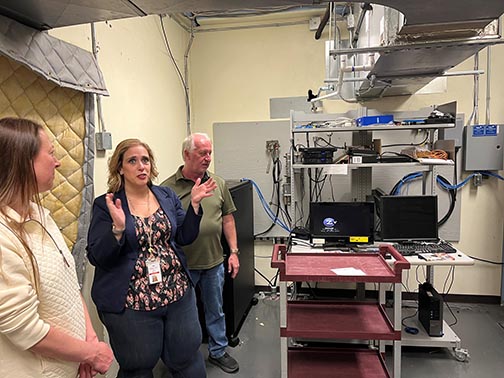
Wetsch helps lead an NDIT tour through the North Dakota Department of Corrections and Rehabilitation, one of her key partner agencies in advancing technology modernization.
Connecting the Dots Across the State
Wetsch’s influence extends beyond any single agency. Her portfolio includes the state’s Vantis program, for example, North Dakota’s nationally recognized network for advanced drone operations, which made headlines as the first system in the country to gain secure access to unfiltered FAA radar data, unlocking beyond-visual-line-of-sight (BVLOS) drone flights for everything from emergency response to agricultural monitoring. Few people realize a TBP was key to bringing everything together.
Wetsch has a knack for seeing connections others don’t. When agencies independently pursue similar tools—like body cameras for Game and Fish, DOCR, and the Highway Patrol—she works to surface overlap early, reducing duplicated contracts and aligning procurement.
She jokes that the role feels like “Charlotte from Charlotte’s Web,” quietly spinning connections and passing them along to whoever needs them next, including statewide portfolio leaders who rely on TBPs for visibility into agency-level needs.
That constant awareness takes discipline. Wetsch stays close to what each agency is working on so emerging trends don’t arrive in isolation. She has also helped standardize how TBPs communicate, so agencies receive consistent framing instead of fragmented messaging.
It’s not a job with a neat definition. It's a constant balancing act of timing, relationships, and translation.
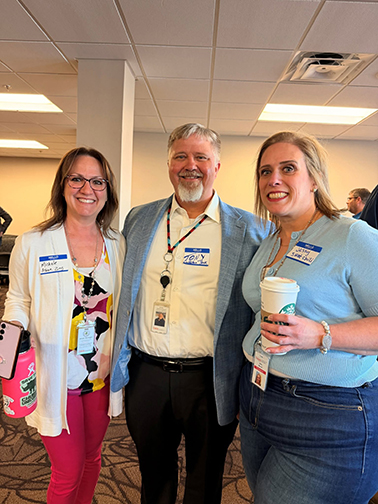
Wetsch thrives on building beautiful relationships through her role, both within NDIT and across the State of North Dakota.
Finding Her Way to NDIT
Wetsch’s path to state government wasn’t linear. A Bismarck native, she once interned in Oil and Gas and assumed she’d leave state work behind. She studied English at Dickinson State University and built a 20-year career in health insurance with Aetna, where frequent travel consumed her life.
Then came the COVID-19 pandemic. For the first time in years, she was home consistently.
“I’m finally here for everything my kids have going on,” she remembers thinking. “Something has to change.”
She joined NDIT in 2020 with limited IT experience but a strong interest in strategy and communication. The learning curve was steep—early weeks filled with unfamiliar acronyms, among other things—but over time she became fluent in infrastructure, networking, and agency operations. More importantly, she never stopped asking clarifying questions others were hesitant to voice.
The tradeoff for leaving private-sector travel was meaningful: presence. Volleyball games, soccer practices, everyday moments—things she previously missed became part of her routine again. Not only that, but she had found an incredible place to work.
A Great Place to Build a Career
Wetsch describes NDIT as a place where trust is given, not constantly monitored. That culture has helped the agency earn recognition as a top workplace in the Bismarck-Mandan region, reflecting a broader effort to invest in people as much as systems.
For her, it’s also about flexibility and mission alignment. The work matters, but so does the environment in which it’s done.
That alignment is what draws and retains people who see their roles as part of something larger: a functioning, modern state government serving real needs across North Dakota.
Outside of work, Wetsch’s storytelling instinct shows up in another form—reading. She’s finished more than 200 books in a single year, mostly audiobooks squeezed into time between school activities and family logistics. She moves easily between fiction and nonfiction, recently including memoirs focused on decision-making under pressure.
That curiosity carries into her parenting as well. When her daughter raised concerns about local recreation facilities for youth, Wetsch didn’t simply agree—she helped connect her with local leadership so she could engage directly.
It’s the same pattern again: notice the gap, then help someone take a step toward filling it.
The Role, Fully Understood
Ask Wetsch what she values most about her job, and she doesn’t point to a headline project. She points to the beginning—the moment when something moves from idea to action.
That preference fits a role built on translation and trust. “Technology Business Partner” sounds technical, but in practice it’s relational. It’s showing up early, asking questions others might not, and helping shape direction before decisions harden.
Sometimes that looks like a legislative funding strategy. Sometimes it’s a drone network. Sometimes it’s a small wooden box filled with food.
Different scale, same approach: listen first, find what’s missing, and help close the gap.
Whether in a state agency meeting, a budget conversation, or a parking lot with her kids, Wetsch operates the same way. She shows up. She pays attention. She helps move things forward.
And in that quiet consistency, North Dakota has something simple but rare: a good partner in Jessy Wetsch.