
How ND’s Chief Data Officer Turned a Lifelong Passion Into a Statewide Mission
It’s a mix of sun and low clouds on this particular November day in Bismarck, the kind of North Dakota sky that can’t quite make up its mind. Inside the Bank of North Dakota’s board room, NDIT’s Executive Leadership team has gathered for one of its quarterly strategy sessions.
There’s something fitting about the setting. The bank’s building was thoughtfully designed to resemble a riverboat, with the board room tucked into the “bow”—a space built around the idea of steering the ship in the right direction. And that’s essentially what the NDIT team is there to do: step away from the day-to-day and chart a course for the agency’s future.
These retreats are highly intentional. Rather than always meeting behind NDIT’s own walls, the executive team gathers at the offices of the very agencies it serves. Each quarter, they spend two days listening, strategizing alongside their agency counterparts, and asking a simple question: How can NDIT serve you better?
Outside the windows, the Missouri River flows past Bismarck’s Memorial Bridge as ideas, questions, and spirited debate fill the room. Cracked laptops line the table. Large, scribble-covered flip-chart sheets stretch along the curved windows facing west. A time-lapse camera sits in the center of the room, quietly compressing hours of deliberate conversation into seconds. Snacks are within arm’s reach for whenever the ideas start flowing faster than anyone can keep up.
It’s the kind of setting where no idea is too big or too small, where a passing comment about one initiative can turn into a 20-minute conversation about the future of the state. And on this particular day, with this particular group, the conversation has a way of circling back to the same place, no matter where it starts.
Data.
“Most of what we’re talking about today doesn’t mean much if we don’t have quality data to support it,” Kim Weis, NDIT’s Chief Data Officer, pipes up.
She’s met with light chuckles and knowing nods around the room before another executive chimes in. “All Kim ever wants to talk about is data, data, data!”
The room erupts in laughter, Weis included. She’s heard that line more times than she can count, and she wouldn’t have it any other way. In true “Marsha, Marsha, Marsha” fashion, it’s become a running joke for the group, received exactly as it’s intended—with plenty of good-natured teasing, but also genuine respect for the person at the center of it.
Weis has a knack for bringing the conversation back to data because, in one form or another, it sits beneath nearly every important discussion. Good decisions require good information. If the data is incomplete, inaccurate, or misunderstood, it becomes much harder to know what’s really happening, determine where resources should go, or measure whether an initiative is having the intended impact.
Amid the lighthearted ribbing, one thing is clear. Everyone at that table has the utmost love and respect for Weis.
And they know she’s 100% right.
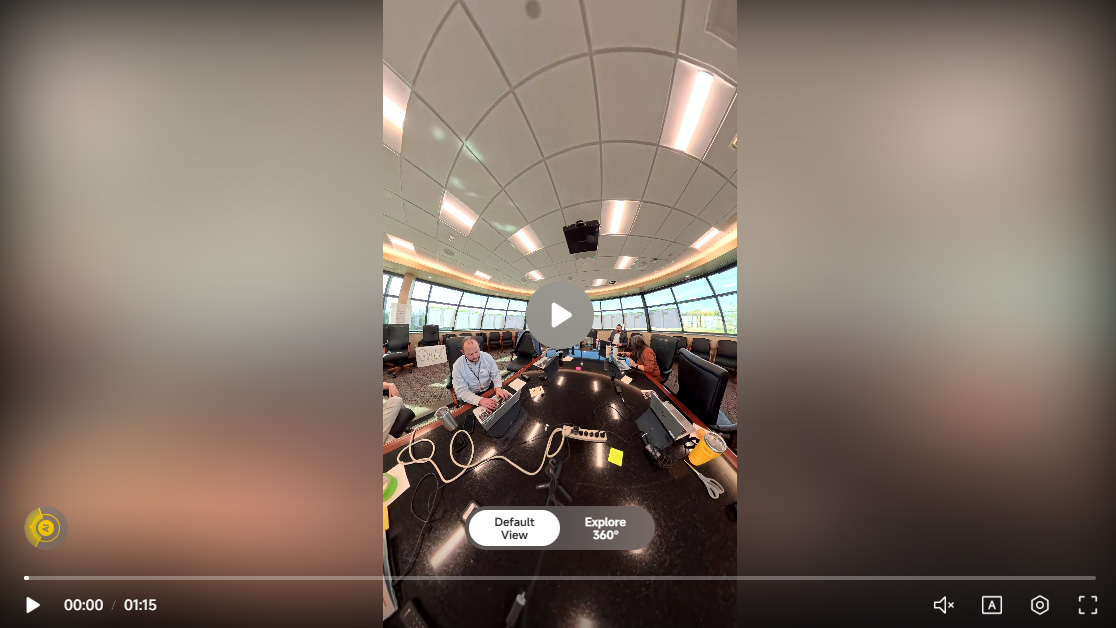
Strategy in motion! NDIT’s Executive Leadership team spends two days listening, collaborating, and charting a course for the future.
A Roundabout Path to a Perfect Fit
Weis didn’t set out to become a Chief Data Officer, or even to work in technology for that matter. Her academic background is in genetics, biochemistry, and molecular biology. She once had her sights set on a career as a research scientist. She loved the work…but something was missing.
“I wanted to be able to do something that I felt had a more direct impact,” Weis says, “instead of doing research and development, where you’re behind the scenes and maybe you make this little discovery.”
She went looking for a field that combined her scientific training with a clearer sense of purpose, and found it in epidemiology, specifically genetic epidemiology, which let her apply everything she’d learned toward public health.
After a few years studying cardiovascular disease and genetic epidemiology at the University of Minnesota, Weis and her late husband decided to move back to her hometown of Bismarck to be closer to family. She landed a role with North Dakota Health and Human Services as its viral hepatitis coordinator, running the state’s prevention and control program. And because it was a brand-new program, she got to do something she loved even more: the data work itself.
She analyzed trends. She studied risk factors. She learned hands-on what data can tell you about a population, and just as importantly, what it can’t. It was there that her love for data truly took root.
But when the role shifted more toward grant administration and away from hands-on analysis, Weis moved to what was then a separate human services agency as a research analyst—essentially a data analyst role—helping program areas use their data to make more informed decisions. She spent a decade there, eventually working her way to lead the research team, before North Dakota’s government unification effort brought her entire team into NDIT in 2019.
Weis didn’t grow up dreaming of an IT career, and she’s quick to say so. But she knew immediately—something about the move felt right. Like it was exactly where she was meant to be.
Progressing Through a Pandemic
Not long after Weis joined NDIT, the world changed. The COVID-19 pandemic hit, and suddenly her public health background and her new technology role collided head-on.
“While that was an extremely difficult time for everyone, it was the chance for me to offer my expertise and help,” Weis says of the pandemic response.
For someone who had spent her career building toward exactly this intersection of public health and data, the moment reignited every ounce of her passion. “It’s all my public health knowledge,” she says, describing how quickly everything she’d learned came rushing back into use.
The pandemic also exposed something Weis had long suspected: North Dakota, like most of the country, wasn’t nearly as mature with its data as it needed to be to respond quickly to a crisis of that scale.
Rather than treat that as discouraging, Weis saw it as clarifying. It created what she calls “the perfect storm” for building something better—an enterprise approach to data and analytics that didn’t just give agencies new technology, but helped them build the governance, the culture, and the strategic foundation to actually use their data well.
Data All Day Every Day
Ask Weis where her data obsession shows up outside of work, and she doesn't hesitate.
“It’s never far from my mind in everything I do,” she chuckles. “Any article I read, any number that’s quoted in anything—social media, my kids come home and say something—I immediately go to, ‘I’d be curious to understand how that study was designed.’”
Weis’ kids, all over 16, have learned to see it coming from a mile away. “Oh my gosh, Mom, enough with the data!” they’ll often say. Weis just laughs. The wheels don’t stop turning, and she’s made peace with that, mostly because data works.
Then there’s Weis’ spreadsheet obsession. She readily admits she has one for nearly everything at home—recipes she wants to try, family finances, vacation planning, budgeting lessons for her kids.
Even her family’s travels aren’t safe from her analytical streak. Picture Weis at the airport, scanning flight boards and gate maps in real time, quietly calculating the fastest path between terminals—three minutes on the shuttle, or a faster route on foot—while her daughter groans, “Mom, please.”
Weis pulls spreadsheets out again and again, tweaking and refining them the same way she’d refine a data model at work. It’s not a chore for her. It’s fun!

When she’s not talking data, Weis loves making memories with the people who matter most.
‘Limitless’ Opportunities
When asked what excites her most about data’s potential for North Dakota, Weis doesn’t hold back.
“It’s limitless,” she says with a smile. Her mind immediately goes to public health outcomes—tracking chronic and acute disease trends, making sure the right services are in place before problems grow more costly to treat.
But it doesn’t stop there. She points to economic stability, employment, and self-sufficiency for residents. She also references something as simple as renewing a fishing license online, and the broader expectation citizens now have for a seamless, “Amazon-like” experience with their government. She also points to something that’s driven her since her first day in public service: making sure taxpayer dollars are used as effectively as possible.
Underneath all of it is a conviction Weis has carried since her earliest days working with messy, disconnected data systems: that data isn’t something IT owns on an agency’s behalf. It belongs to the business areas that create it and rely on it. Getting that governance right—the people, the processes, the roles—has to come before the technology, not after it.
It’s a philosophy she and the other executives sum up simply: “Technology alone is never the answer. People alone is never the answer. Process alone is never the answer. It takes all of those together to come to a good solution.”
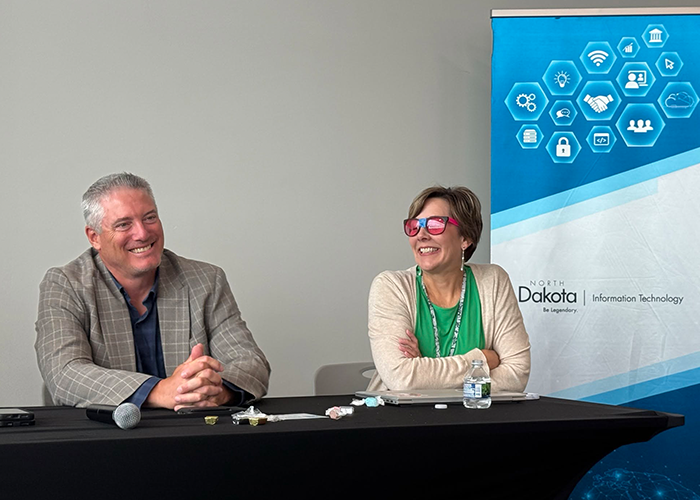
Serious about data, not always serious about herself, Weis brings plenty of personality to the table. She’s never afraid to have a little fun.
A Culture Worth Celebrating
Ask anyone at NDIT about Weis, and people are quick to talk about her warmth, her humor. The way her eyes light up and her whole energy shifts the moment a conversation turns to data, which, as her colleagues will happily tell you, is often.
She’s become a familiar and beloved presence at NDIT’s all-team gatherings, for example, where team members still talk about the year she showed up to share her long-term vision for data at the state—goofy glasses and all, fully embracing the moment right alongside the message.
That kind of culture is part of why NDIT has been named a Top 10 Workplace by the Bismarck-Mandan Young Professionals Network two years running, a distinction Weis says reflects something real about the agency, not just a nice line on a website. Between the mission, the people, and a benefits package that supports team members’ lives outside of work, she doesn’t have to look far for reasons to recommend NDIT to others.
Her favorite part of the job, though, always comes back to the same thing.
“The work that we’re doing and the impact that it has on the residents of North Dakota matters,” she says. “We’re here in government to serve the people, and what a super fulfilling mission that is.”
That sense of purpose is the same thing Weis points to whenever someone asks her why they should consider a career at NDIT. “I feel like working in the public sector is a calling,” she’ll always say. It’s a sentiment that much of NDIT echoes.
We likely even have the data to back it up.